Reflection Blog Post #2 – Annotation
We’ve all been there, scrolling through a long article or a dense research paper, only to realize at the bottom of the page that we haven’t actually retained a single sentence. I know I have! It’s easy for digital reading to become passive, but the focus on social annotation offers a way to actually “talk back” to the text.
Remi Kalir’s talk on social annotation (Click here for the talk) really showed that annotation is everywhere, we may just miss it for example the following picture from Remi’s talk shows how the fencing can be transformed into a collective, communal text. As Remi pointed out, adding the phrase “Every wall is a challenge” transformed a physical barrier into a site of social commentary.
This is what he calls a counter-narrative. By adding a note to a text, whether that text is a monument, a stop sign, or a digital PDF, we aren’t just reading the world, we are actively rewriting it. It’s a reminder that history and information are constantly being interpreted and contested by those who leave their mark.
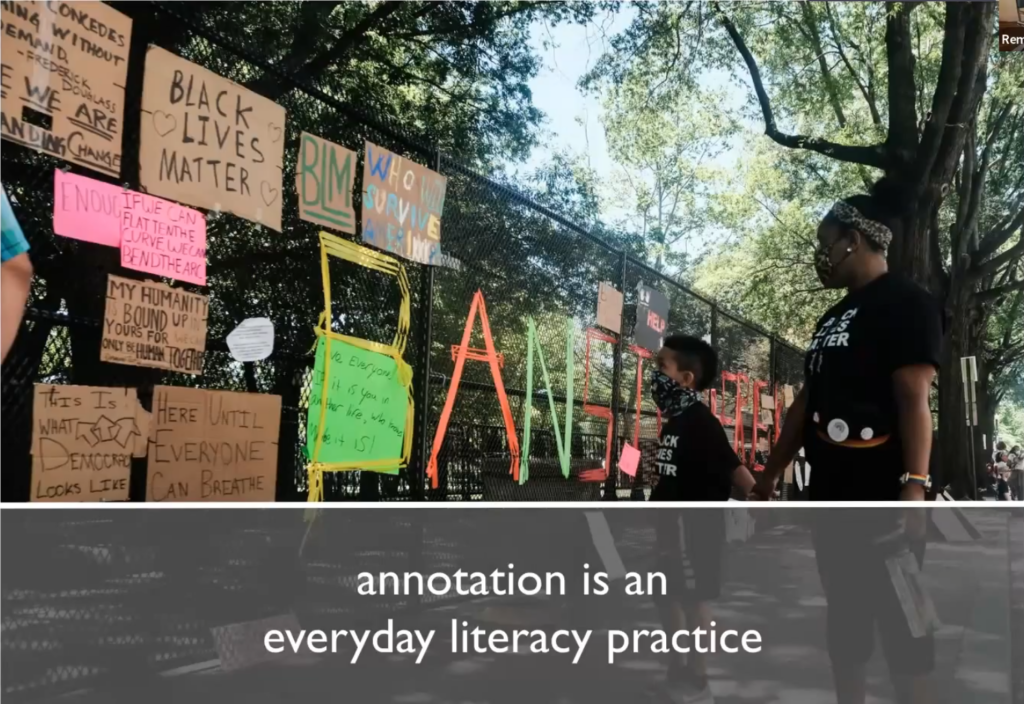
As Remi explained, the signs and messages left on this fence are powerful examples of annotation as a civic literacy practice. He pointed out how these notes aren’t just random; they are:
- Intertextual: One sign reads, “If we can flatten the curve, we can bend the arc,” cleverly connecting the COVID-19 pandemic to the long-standing “arc of justice.”
- Dialogic: The messages on the fence aren’t isolated. They speak to each other, to the government behind the fence, and to the people walking by, like Jalen and Angelica Cuevas (the two people pictured).
- Multimodal: The use of bright colors, hand-drawn symbols like “BLM,” and even protest chants written out (“This is what democracy looks like”) all work together to create meaning.
This image reminds us that annotation isn’t just about highlighting a textbook in a library, it’s about marking our place in history and contest the social context around us. By adding our voices to the texts of our world, we move from passive observers to active participant.
We can annotate ourselves using a tool Remi showed us called Hypothes.is which is a digital highlighter and a sticky note that works on almost any website or PDF. It is an open-source tool that sits as a transparent “layer” over the internet. Instead of just reading a webpage, it allows you to select text and leave a comment, a question, or a link right there on the original document, so anyone can annotate and read others’ annotations.
Ultimately, social annotation transforms the passive act of digital reading into a communal experience. By treating everything from a research PDF to a physical protest fence as a canvas for commentary, tools like Hypothes.is allow us to move beyond simple consumption to engage in an active dialogue with our peers. This practice doesn’t just help us retain information, it empowers us to challenge existing narratives and contribute our own voices to the ongoing history of the texts we encounter.